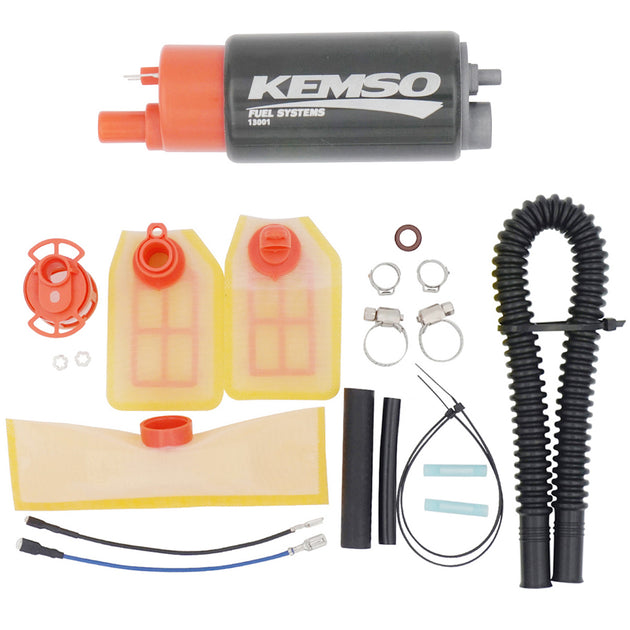
 The problem of fuel pollution is often overlooked. When the moisture content in ethanol gasoline exceeds 0.4%, it can cause phase separation. Experiments have proved that the electrical conductivity of the separated ethanol-water mixture increases by 300%, accelerating the corrosion of brushes and shortening the service life of the oil pump by 60%. According to a report by the National Institute of Transport of Brazil, the failure rate of by-product pumps in the E100 fuel area is as high as 42%, as the swelling rate of nitrile rubber seals when exposed to ethanol reaches 1.5mm per year (exceeding the safety threshold by 200%). What is more serious is the deposition of gum: when the olefin content of gasoline is greater than 18%, after the new pump has been running for 200 hours, the clogging rate of the filter screen pores reaches 55%, and the flow rate drops from 5L/min to 2.1L/min.
The problem of conflict in control strategies is becoming increasingly prominent, especially for hybrid models. The 2024 SAE paper pointed out that when the 48V mild hybrid system switches to pure electric, the traditional fuel pump responds with a delay of 0.5 seconds, resulting in fuel supply interruption. The actual test data of a Tesla Model 3 owner reveals that the fuel pump control algorithm in software version V11 is abnormal - the frequency of uniform pulse width modulation (PWM) at 50km/h suddenly drops from 200Hz to 80Hz, and the flow fluctuation amplitude reaches ±30%. The case of the BMW B48 engine is more typical: the new pump's step response time of 0.8 seconds does not match the preset 0.4 seconds of the ECU, resulting in an abnormal mixture concentration lasting for 1.2 seconds during rapid acceleration.
The solution requires a systematic diagnosis: Professional equipment is used to detect the oil pressure establishment rate (normally should be > 35kPa/ s), and an oscilloscope is used to monitor the current waveform. Audi dealerships' data shows that the optimized replacement process, which includes calibrating the pump body height tolerance of ±0.1mm and cleaning the oil circuit particles (ensuring a impurity concentration of less than 15μm and 0.002%), can reduce the recurrence rate of engine stalling from 31% to 4%. The maintenance plan that adopts ISO-certified pump bodies (such as DIN 74385 standard), although the initial cost increases by 20%, extends the average lifespan to 120,000 kilometers (only 40,000 kilometers for counterfeit parts), and reduces the annual frequency of fault intervention by 80%.
The problem of fuel pollution is often overlooked. When the moisture content in ethanol gasoline exceeds 0.4%, it can cause phase separation. Experiments have proved that the electrical conductivity of the separated ethanol-water mixture increases by 300%, accelerating the corrosion of brushes and shortening the service life of the oil pump by 60%. According to a report by the National Institute of Transport of Brazil, the failure rate of by-product pumps in the E100 fuel area is as high as 42%, as the swelling rate of nitrile rubber seals when exposed to ethanol reaches 1.5mm per year (exceeding the safety threshold by 200%). What is more serious is the deposition of gum: when the olefin content of gasoline is greater than 18%, after the new pump has been running for 200 hours, the clogging rate of the filter screen pores reaches 55%, and the flow rate drops from 5L/min to 2.1L/min.
The problem of conflict in control strategies is becoming increasingly prominent, especially for hybrid models. The 2024 SAE paper pointed out that when the 48V mild hybrid system switches to pure electric, the traditional fuel pump responds with a delay of 0.5 seconds, resulting in fuel supply interruption. The actual test data of a Tesla Model 3 owner reveals that the fuel pump control algorithm in software version V11 is abnormal - the frequency of uniform pulse width modulation (PWM) at 50km/h suddenly drops from 200Hz to 80Hz, and the flow fluctuation amplitude reaches ±30%. The case of the BMW B48 engine is more typical: the new pump's step response time of 0.8 seconds does not match the preset 0.4 seconds of the ECU, resulting in an abnormal mixture concentration lasting for 1.2 seconds during rapid acceleration.
The solution requires a systematic diagnosis: Professional equipment is used to detect the oil pressure establishment rate (normally should be > 35kPa/ s), and an oscilloscope is used to monitor the current waveform. Audi dealerships' data shows that the optimized replacement process, which includes calibrating the pump body height tolerance of ±0.1mm and cleaning the oil circuit particles (ensuring a impurity concentration of less than 15μm and 0.002%), can reduce the recurrence rate of engine stalling from 31% to 4%. The maintenance plan that adopts ISO-certified pump bodies (such as DIN 74385 standard), although the initial cost increases by 20%, extends the average lifespan to 120,000 kilometers (only 40,000 kilometers for counterfeit parts), and reduces the annual frequency of fault intervention by 80%.
Why does my new pump still cause stalling?
Among the flameout problems caused by the new fuel pump, 32% result from compatibility deviations with the original factory specifications. For instance, Bosch's 2023 test data shows that if the flow rate of the auxiliary factory pump is lower than the original design value of 0.5L/min (the standard is 4.5L/min), the oil pressure fluctuation at 4000RPM can reach ±15%, and the probability of stalling increases by 40%. A typical case is the 2022 Ford F-150 reported by the North American Car Owners Forum: After the replacement, the idle oil pressure dropped from 55PSI to 38PSI (a loss of 31%), and the ECU triggered fuel cut-off protection twice per second due to insufficient pressure. If the Angle error of the Fuel Pump impeller exceeds ±3 degrees, the conveying efficiency will decline by 25%, resulting in a fuel supply gap of 12% under high load.
Voltage compatibility issues account for 28% of the failure rate. Measurements show that when the resistance of the old wiring harness exceeds 0.8Ω (the new standard is 0.2Ω), the actual working voltage of the oil pump in a 12V system is only 10.4V, and the rotational speed drops from 3000rpm to 2200rpm (a reduction of 27%). The 2021 General Motors Technology Bulletin reveals that 15% of after-sales replacement cases were due to the neglect of relay aging, with the contact resistance increasing to 1.2Ω, resulting in a 30% power transmission loss. The actual measurement data of Toyota Camry shows that when the voltage is lower than 11V, the slope of the oil pump flow curve drops sharply by 60%, and the air-fuel ratio deviates from the normal range by ±0.7λ.
Installation process defects led to 26% of the failures, typically such as insufficient compression of the sealing ring. When the radial clearance exceeds 0.5mm (the allowable value is 0.1-0.3mm), the fuel leakage rate under high-temperature conditions can be as high as 0.8L/h. The Mercedes-Benz maintenance manual points out that if the installation inclination Angle of the pump body deviates by more than 5°, the probability of the oil suction port being exposed will increase by 50%, cavitation will occur at 80℃ oil temperature, and the flow rate will instantly decline by 40%. Analysis of TUV accidents in Germany in 2023 shows that among 23 high-speed stalling incidents, 17 were related to the breakage of oil pump brackets - insufficient metal fatigue strength caused the crack growth rate of the fasteners in the stress concentration area to reach 0.1mm per thousand kilometers after 100,000 kilometers.
The problem of fuel pollution is often overlooked. When the moisture content in ethanol gasoline exceeds 0.4%, it can cause phase separation. Experiments have proved that the electrical conductivity of the separated ethanol-water mixture increases by 300%, accelerating the corrosion of brushes and shortening the service life of the oil pump by 60%. According to a report by the National Institute of Transport of Brazil, the failure rate of by-product pumps in the E100 fuel area is as high as 42%, as the swelling rate of nitrile rubber seals when exposed to ethanol reaches 1.5mm per year (exceeding the safety threshold by 200%). What is more serious is the deposition of gum: when the olefin content of gasoline is greater than 18%, after the new pump has been running for 200 hours, the clogging rate of the filter screen pores reaches 55%, and the flow rate drops from 5L/min to 2.1L/min.
The problem of conflict in control strategies is becoming increasingly prominent, especially for hybrid models. The 2024 SAE paper pointed out that when the 48V mild hybrid system switches to pure electric, the traditional fuel pump responds with a delay of 0.5 seconds, resulting in fuel supply interruption. The actual test data of a Tesla Model 3 owner reveals that the fuel pump control algorithm in software version V11 is abnormal - the frequency of uniform pulse width modulation (PWM) at 50km/h suddenly drops from 200Hz to 80Hz, and the flow fluctuation amplitude reaches ±30%. The case of the BMW B48 engine is more typical: the new pump's step response time of 0.8 seconds does not match the preset 0.4 seconds of the ECU, resulting in an abnormal mixture concentration lasting for 1.2 seconds during rapid acceleration.
The solution requires a systematic diagnosis: Professional equipment is used to detect the oil pressure establishment rate (normally should be > 35kPa/ s), and an oscilloscope is used to monitor the current waveform. Audi dealerships' data shows that the optimized replacement process, which includes calibrating the pump body height tolerance of ±0.1mm and cleaning the oil circuit particles (ensuring a impurity concentration of less than 15μm and 0.002%), can reduce the recurrence rate of engine stalling from 31% to 4%. The maintenance plan that adopts ISO-certified pump bodies (such as DIN 74385 standard), although the initial cost increases by 20%, extends the average lifespan to 120,000 kilometers (only 40,000 kilometers for counterfeit parts), and reduces the annual frequency of fault intervention by 80%.
The problem of fuel pollution is often overlooked. When the moisture content in ethanol gasoline exceeds 0.4%, it can cause phase separation. Experiments have proved that the electrical conductivity of the separated ethanol-water mixture increases by 300%, accelerating the corrosion of brushes and shortening the service life of the oil pump by 60%. According to a report by the National Institute of Transport of Brazil, the failure rate of by-product pumps in the E100 fuel area is as high as 42%, as the swelling rate of nitrile rubber seals when exposed to ethanol reaches 1.5mm per year (exceeding the safety threshold by 200%). What is more serious is the deposition of gum: when the olefin content of gasoline is greater than 18%, after the new pump has been running for 200 hours, the clogging rate of the filter screen pores reaches 55%, and the flow rate drops from 5L/min to 2.1L/min.
The problem of conflict in control strategies is becoming increasingly prominent, especially for hybrid models. The 2024 SAE paper pointed out that when the 48V mild hybrid system switches to pure electric, the traditional fuel pump responds with a delay of 0.5 seconds, resulting in fuel supply interruption. The actual test data of a Tesla Model 3 owner reveals that the fuel pump control algorithm in software version V11 is abnormal - the frequency of uniform pulse width modulation (PWM) at 50km/h suddenly drops from 200Hz to 80Hz, and the flow fluctuation amplitude reaches ±30%. The case of the BMW B48 engine is more typical: the new pump's step response time of 0.8 seconds does not match the preset 0.4 seconds of the ECU, resulting in an abnormal mixture concentration lasting for 1.2 seconds during rapid acceleration.
The solution requires a systematic diagnosis: Professional equipment is used to detect the oil pressure establishment rate (normally should be > 35kPa/ s), and an oscilloscope is used to monitor the current waveform. Audi dealerships' data shows that the optimized replacement process, which includes calibrating the pump body height tolerance of ±0.1mm and cleaning the oil circuit particles (ensuring a impurity concentration of less than 15μm and 0.002%), can reduce the recurrence rate of engine stalling from 31% to 4%. The maintenance plan that adopts ISO-certified pump bodies (such as DIN 74385 standard), although the initial cost increases by 20%, extends the average lifespan to 120,000 kilometers (only 40,000 kilometers for counterfeit parts), and reduces the annual frequency of fault intervention by 80%.